
Managing the ACD Heeling Instinct: Why Cattle Dogs Nip and How to Redirect It
- May 11
- 7 min read
Updated: May 19
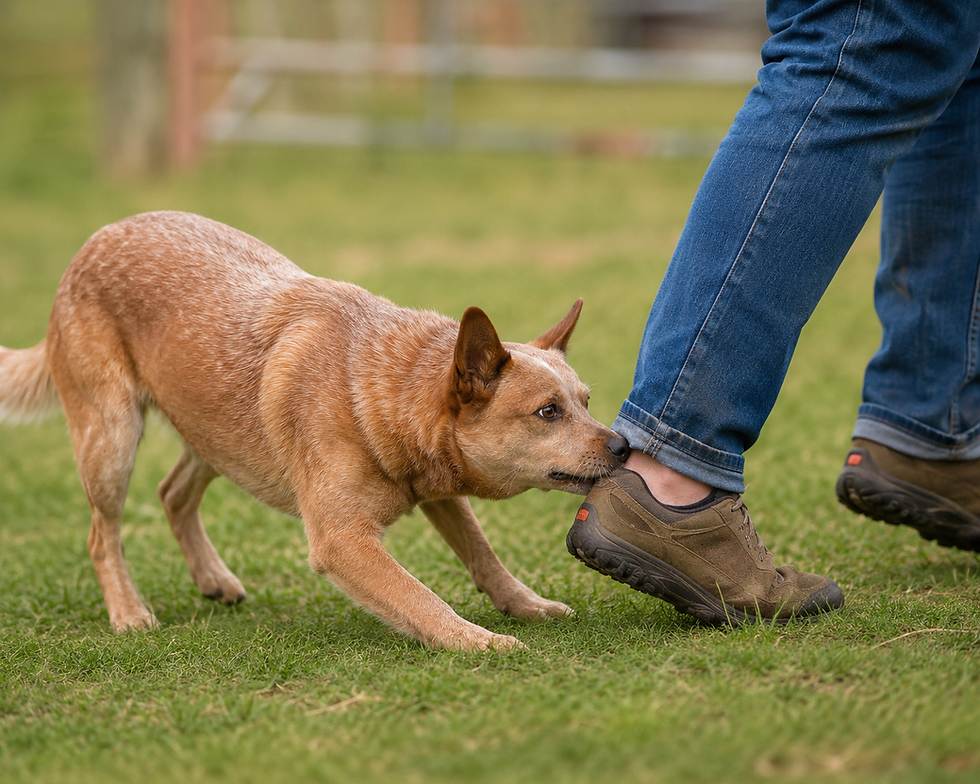
The Australian Cattle Dog was bred to nip the heels of cattle. Specifically, to redirect a half-ton steer hard enough to move it without breaking skin or tooth, a calibrated working behavior has been selected for more than 150 years. That instinct doesn’t switch off when the dog moves to a suburban yard, which is why most ACD pet parents bump into the heeling drive somewhere in the first year at home: heel grabs during play, ankle nips when kids run by, the dog quietly trying to herd joggers on a walk.
Nipping is manageable, and most ACDs can be redirected into productive outlets with consistent structure. It helps to understand where the drive comes from and how it actually shows up at home, alongside what training approaches work and what the legal stakes look like if a nip ever escalates into something more serious.
Where the Heeling Drive Comes From
The Australian Cattle Dog was developed in 19th-century Australia by ranchers who needed a stockdog with the stamina to drive cattle hundreds of miles across rough country. Earlier herding breeds imported from Britain couldn’t handle the conditions or the cattle, so Australian breeders began crossing dingoes with smooth-coated collies, then later adding Dalmatians and Australian Kelpies. The mix produced a dog that worked silently, ran for hours, and controlled stubborn livestock by ducking in low and nipping at the heels.
A working ACD nips with calibration. The behavior had to be precise, repeatable, and selectively applied to specific stock under specific conditions, and that level of fine-tuned control is what made the breed indispensable on cattle stations. Even households that have never seen cattle end up living with the same calibrated drive, just aimed at whatever the dog can find to control.
ACDs raised entirely as pets still go looking for movement to control. The cattle dog’s working origin sits underneath everything else about the breed, and the strategies that work consistently across ACDs are the ones that account for the drive instead of trying to suppress it. Most management plans that fail are ones that treat heeling as bad behavior to be punished out, when it’s actually a hardwired drive that needs somewhere to go.
How Nipping Shows Up at Home
In a household setting, the heeling drive aims at whatever moves. Kids running through the yard, joggers passing on the sidewalk, a partner walking through the kitchen too quickly, and even other dogs trying to walk past the food bowl can become targets. The textbook example is heel-grabbing during play, but the realistic version is broader and shows up in patterns most pet parents only recognize after a few months of observation.
There are usually three flavors of household nipping. Drive-based nipping shows up during play and household transitions and is the most common version. Frustration-based nipping shows up when the dog tries to move things around, and they refuse to move, often during feeding routines or doorway negotiations. Bored or under-exercised nipping escalates fastest, because the energy has nowhere else to go, and most ACDs reach an under-stimulated state by mid-week if the routine doesn’t include real mental work alongside physical exercise.
Pay attention to where the behavior shows up most for your specific dog. The dog who only nips during fast movement needs a different management plan than the dog who nips around the food bowl, and the dog who nips when bored is a different problem than the dog who nips on transitions. Whatever your household looks like, living with an Australian Cattle Dog means budgeting real time and structure into the daily routine, and the better you can name the trigger pattern, the faster the management plan comes together.
Activities That Channel the Drive
The fastest way to reduce nipping is to give the heeling drive somewhere legitimate to go. Working ACDs herd; pet ACDs need substitutes that satisfy the same instinct. Treibball, a dog sport that uses large exercise balls in place of cattle, is one of the closest substitutes for actual herding and channels the heeling drive into a structured task. The dog learns to push, drive, and gather large objects under handler cues, and the parallel to livestock work is close enough that most ACDs take to it quickly.
Other strong outlets include agility, dock diving, scent work, barn hunt, rally obedience, and any sport that involves precision under arousal. Herding clinics with experienced trainers are available in many parts of the country and let the dog work actual livestock under controlled conditions, often as a single weekend introduction or an ongoing class. ACDRA fosters and adopters can usually point new owners toward local clinics and instructors through breed networks.
Mental work matters as much as physical exercise, and that’s where many first-time ACD pet parents underinvest. A long walk alone won’t satisfy an ACD; a long walk plus a focused training session usually does. Aim for at least one cognitively demanding activity each day, whether that’s a puzzle feeder, mat work, recall games in the yard, or fifteen minutes of obedience drills indoors. The shorthand most experienced ACD owners share: a tired ACD is a manageable ACD, and tired in this breed means mentally tired more than physically.
Three Cues That Help You Stay Ahead of Nipping
Three foundation cues do most of the heavy lifting in nipping management:
“Leave it” gives a verbal stop before the dog commits to a heel-grab.
“Place” sends the dog to a designated spot when arousal spikes during a transition or visitor arrival.
A reliable recall lets you interrupt a chase pattern before it ends with someone’s pant leg.
These aren’t ACD-specific cues, but ACDs typically need more reps than other breeds to fully generalize them across contexts. Train each cue in the kitchen, on walks, around guests, around children, and around other dogs. A cue that works in the living room when nothing is happening doesn’t automatically transfer to the backyard during a soccer game.
Build the response under low distraction first, then layer harder environments deliberately. Owners whose ACDs respond reliably are the ones who keep training as a permanent practice, not a six-week obedience class. The breed responds well to short daily sessions in the ten-to-fifteen-minute range, repeated consistently over months. Reward systems matter too: high-value treats, real food, and play tend to work better than dry training treats for most ACDs, especially during higher-arousal sessions.
When a Nip Becomes a Real Bite
Nipping and biting sit on the same continuum, and the line moves more easily than most pet parents expect. A frustrated, over-aroused dog can deliver a real bite while still believing it’s herding, especially when the dog has a long history of unchecked nipping that has gradually escalated without meaningful redirection. Dog training collars from brand such as Calmshops can help to prevent unwanted behavior.
The early signals usually show up in body language well before the teeth do. Stiff body, hard stare, closed mouth, low growl, lip lift, or a freeze just before the lunge are common precursors and tend to appear in roughly that order as arousal climbs. Spending serious time on the early warning signs of dog bites prevents most preventable bites in this breed, and learning to read body language costs nothing beyond a few hours of focused observation across different contexts.
If the behavior has already produced a real bite, that’s the point to bring in a credentialed behaviorist rather than a YouTube training series. Severity matters too: a bite that breaks skin or punctures is a different conversation than a bite that bruises, both clinically and legally. Single-incident bites with no prior history can sometimes be addressed in a few targeted sessions; repeated escalating bites usually require longer intervention and sometimes management decisions about household setup.
The Legal Side ACD Pet Parents Should Understand
Most pet parents never have to think about dog bite law, but every ACD owner probably should. State law shapes what a single incident actually means for you, and the breed’s heeling reputation can work against you if a complaint reaches an animal control officer or ends up in a civil filing. Even an unprovoked nip on a guest at your front door can trigger consequences depending on local statutes.
Some states use strict liability for dog bites, where the owner is on the hook from the very first incident, with narrow defenses. Others follow the older one-bite liability rule, where the owner is only liable if they already knew the dog was dangerous. The state you live in changes how a single incident plays out, what defenses are available, what damages can be pursued, and how long a victim has to file a claim. Look up your state’s statute language before something happens, not after.
Document any prior nipping incidents in writing, even minor ones. That documentation affects both legal exposure and how a behaviorist evaluates the dog later, and it can become important if a future incident leads to a civil claim. Keep notes on what triggered each incident, who was present, how the dog responded afterward, and any veterinary or behavioral consultation that followed.
Most homeowners and renters insurance policies cover dog bite liability up to a stated limit, but breed exclusions and breed-specific riders are common. Some carriers exclude ACDs by name; others require a separate rider for any working or herding breed. Check the policy language directly, and don’t assume coverage just because the policy is active.
The Bottom Line
The ACDs who do best with the heeling drive end up in homes that work with the instinct, not against it. Pick one redirect activity and one foundation cue to focus on for the next month, and commit to twenty minutes of daily focused work. Track which situations trigger nipping in your specific dog, and which combinations of exercise plus mental work reliably bring the drive back to baseline. Patterns will surface within a few weeks if you’re paying attention.
Most nipping issues respond to consistent structure, and most pet parents handle them on their own without formal intervention. Behaviorists are valuable for serious cases, but the majority of household nipping comes down to redirecting activities, foundation cues, and a routine that respects what the breed was bred to do. The dogs who end up in rescue often come from homes that asked too little of them or too much; very few come from homes that genuinely understood the breed’s working drive.
If you adopted from ACDRA, foster contacts and breed mentors are available across the rescue network, and most experienced ACD owners share what worked for their dogs. The breed rewards pet parents who keep showing up: same training session every day until the cue holds under real stimulation, same redirect activity until it becomes the dog’s default outlet for the drive. Most everything else about owning an ACD gets easier once that foundation is built.

